
How AI Is Driving Science Toward a Greener and More Sustainable Future
Artificial intelligence is changing how scientists discover, design, and evaluate materials. For green and sustainable science, the real opportunity is not simply faster discovery, but better decisions across the full life cycle of materials, from design and synthesis to use, recovery, and recycling.
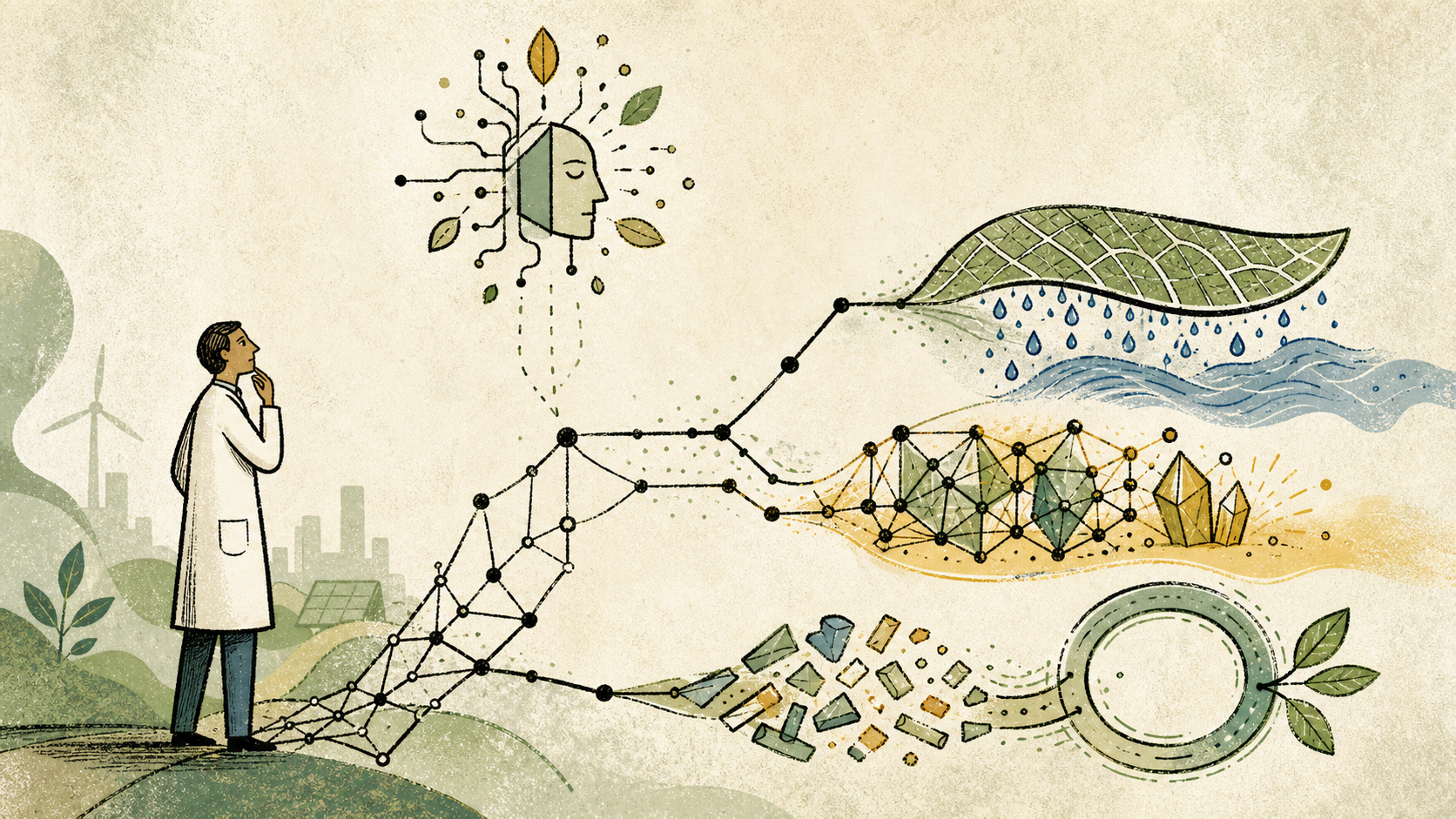
Artificial intelligence (AI) is no longer only a tool for data scientists. It is becoming part of the daily language of materials science, chemistry, environmental engineering, energy research, and manufacturing. Researchers now use AI to screen candidate materials, predict properties, optimize synthesis conditions, interpret characterization data, and search scientific literature at a scale that would be impossible by manual work alone.
For green and sustainable science, this shift matters deeply. Sustainability is not a single property that can be measured in isolation. A material may perform well in the laboratory but require toxic precursors, rare elements, high-temperature processing, or energy-intensive purification. Another material may be less perfect in performance but more scalable, recyclable, repairable, or locally available. AI can help researchers compare these trade-offs earlier and more systematically.
From Trial-and-Error to Guided Discovery
Traditional materials discovery often depends on long cycles of trial, failure, refinement, and repetition. This experimental process remains essential, but AI can make it more directed. Machine learning models can learn from previous experimental and computational data, then predict which compositions, structures, or processing conditions are most likely to produce the desired properties.
In materials research, this is especially useful because the possible design space is enormous. A small change in composition, morphology, surface chemistry, or processing temperature can strongly influence performance. AI can help narrow the search, allowing researchers to test fewer candidates while still exploring a wider scientific landscape.
This is already shaping areas relevant to sustainability, including catalysts, batteries, polymers, adsorbents, membranes, photocatalysts, and materials for carbon capture, water treatment, and renewable energy conversion. Instead of asking only "Which material has the best performance?", researchers can increasingly ask "Which material offers the best balance of performance, stability, cost, toxicity, abundance, and environmental impact?"
Connecting Performance with Sustainability Metrics
One of the most important future roles of AI is connecting materials performance with sustainability metrics. In many studies, sustainability is still discussed after the material has already been developed. A greener scientific workflow would bring sustainability into the design stage.
AI can support this by integrating different types of information: experimental data, computational predictions, life-cycle assessment, techno-economic analysis, supply-chain risk, recyclability, and end-of-life scenarios. This kind of integration can help researchers identify materials that are not only high-performing but also more compatible with circular economy principles.
For example, AI-assisted screening could prioritize materials based on earth abundance, lower processing energy, reduced solvent toxicity, or easier recycling. In polymer research, AI can support the design of materials with targeted durability during use and controlled degradation or recyclability after use. In membrane science, AI can help optimize selectivity, permeability, fouling resistance, lifetime, and fabrication conditions at the same time.
Accelerating Greener Laboratories and Processes
AI is also useful beyond material selection. It can improve how experiments and processes are performed. In chemical and materials laboratories, AI-guided optimization can reduce the number of experiments required to reach a useful formulation or synthesis condition. Fewer experiments can mean lower reagent consumption, less waste, and reduced energy use.
In manufacturing, AI can support process control, predictive maintenance, energy optimization, and quality monitoring. This matters because sustainability is not only about inventing new materials; it is also about producing existing and future materials with fewer resources and less waste.
The rise of autonomous laboratories may further accelerate this direction. In these systems, AI models propose experiments, robotic platforms perform them, and new data are fed back into the model. If designed carefully, such closed-loop systems could help researchers optimize for both scientific performance and environmental responsibility.
AI for Environmental Monitoring and Decision-Making
AI can also support sustainability by improving how we monitor environmental systems. Machine learning is increasingly used in water quality prediction, waste treatment optimization, emissions tracking, climate-risk analysis, and remote sensing. For researchers working on green and sustainable materials, this creates an important bridge between materials innovation and real-world environmental outcomes.
For instance, an adsorbent or membrane may be designed for pollutant removal, but its true value depends on the complexity of real water systems, operating conditions, regeneration, lifetime, and disposal. AI can help analyze these multi-variable systems and identify where a material is most likely to deliver practical benefit.
The Caution: AI Itself Has a Footprint
It is important not to treat AI as automatically sustainable. Large AI models and data centers consume electricity, water, land, and hardware resources. The growth of AI infrastructure also depends on minerals, electronic components, cooling systems, and supply chains that have environmental and social impacts.
This means that the question is not simply "Can AI help sustainability?" but "When does AI create more sustainability value than the resources it consumes?" Small, targeted models trained on high-quality scientific data may often be more appropriate than unnecessarily large systems. Transparent reporting of computational cost, data quality, model uncertainty, and environmental assumptions should become part of responsible AI-assisted research.
What This Means for Green and Sustainable Materials Science
For the green and sustainable materials community, AI should be viewed as a scientific partner, not a replacement for scientific judgment. It can reveal patterns, accelerate screening, and suggest directions, but researchers must still ask the deeper questions: Is the material safe? Is it scalable? Is it durable? Can it be recycled? Are the raw materials abundant and ethically sourced? Does the full system reduce environmental burden?
The strongest future will combine AI, experimental expertise, life-cycle thinking, and responsible publishing. Journals and societies can play an important role by encouraging authors to describe not only performance improvements, but also sustainability assumptions, data limitations, reproducibility, and potential trade-offs.
AI is helping science move faster. The challenge now is to make sure it also helps science move wisely.
More from the Society
All news →Greensusmater — call for papers for Volume 3, now open for submissions
Our flagship journal on green materials science opens Volume 3 to submissions. Bio-based polymers, recycled composites, and lifecycle-conscious materials innovations are all welcome. APC waived for the first three volumes.
GSMS opens Green and Sustainable Membranes — call for inaugural submissions
Our third peer-reviewed open-access journal is now accepting manuscripts on sustainable membrane materials, separation processes, and energy-efficient applications. Article processing charges are waived for the first three volumes.
GSMS launches Green and Sustainable Environments — inaugural issue now live
Our new open-access journal publishes its first five peer-reviewed articles on environmental remediation, emerging contaminants, and sustainable water treatment in Indonesia. Free to read, free to publish for the first three years.