
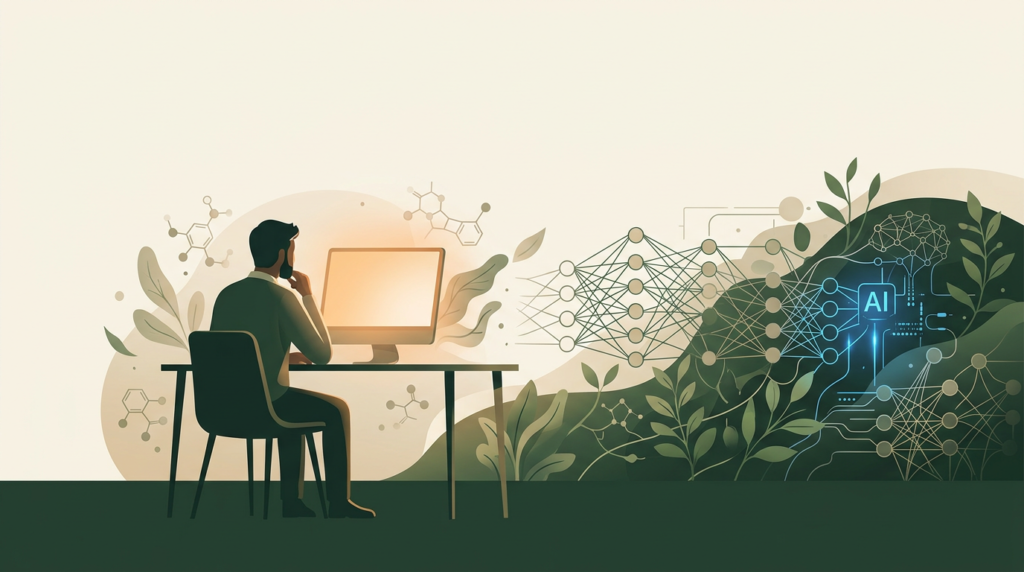
There is a quiet crisis spreading through academia right now — not one of budget cuts or shrinking enrollment, though those are real enough. It is a crisis of meaning.
Ask any active researcher today and somewhere beneath the surface, the question is circling: If AI can synthesize literature, draft manuscripts, structure arguments, and even suggest methodological improvements — what exactly am I contributing?
This is not a question about tools. It is a philosophical one. And before we talk about best practices, we need to sit with that discomfort honestly.
More Than “Just a Tool”
The most common reassurance people reach for is: “AI is just a tool, like any other — it depends on how you use it.”
That is true. But it is also a little too comfortable.
A microscope is a tool. It made certain things visible that were previously invisible, but it did not fundamentally alter what it meant to be a scientist. AI is operating at a different register. It is not merely extending what we can observe — it is beginning to encroach on what we think, how we write, and what we consider intellectual contribution.
In sustainability and materials science, this tension is particularly sharp. Ours is a field built on urgency: the climate is changing, resources are depleting, ecosystems are under pressure. The pressure to publish, to produce, to contribute has never been higher. And now, the machinery to produce text — reviews, proposals, discussion sections, even critical analyses — has become extraordinarily accessible.
The result? A field at risk of drowning in output while starving for genuine insight.
This is the real challenge AI poses to academic careers. Not replacement, but dilution of meaning.
What AI Cannot Do (That You Can)
Once we are honest about the disruption, we can be honest about what remains irreducibly human — and irreducibly yours.
It cannot know your context. AI can explain life cycle assessment methodology in general terms. It cannot know that the electrical grid supplying your region has a specific emission factor, that the biomass feedstock in your locality has a particular supply chain, or that regulatory frameworks in your country create constraints that fundamentally alter what “sustainable” means in practice. Local knowledge, embedded in years of fieldwork, institutional experience, and community engagement, is not in any training dataset.
It cannot have taste. Taste — in the sense of the cultivated ability to distinguish a genuinely interesting research question from a recycled one, a rigorous argument from a superficially plausible one, a meaningful synthesis from an elaborate literature dump — is built from thousands of hours of serious engagement with a field. It cannot be prompted into existence.
It cannot be accountable. When a paper has flawed assumptions, when a recommendation leads to unintended environmental consequences, when a methodology is challenged in peer review — someone must stand behind the work. AI does not attend thesis defenses. It does not face a department committee. It does not sign its name to a study that will influence policy.
It cannot define the right question. This may be the most important point. AI is extraordinarily capable at answering questions. It is far weaker at identifying which questions are worth asking in the first place. The ability to frame a research problem — to see what is missing from a conversation, to recognize the assumption hiding inside a consensus, to ask the uncomfortable question a field has been avoiding — that is where intellectual value actually lives.
Five Shifts Worth Making
With that foundation in place, here are five concrete orientations that distinguish academics who will thrive in this era from those who will struggle.
1. Move from content producer to sense-maker. The scarcest resource in research is no longer information — it is clarity. The academic who can cut through the noise, contextualize findings within broader systems, and communicate what genuinely matters will be more valuable than one who can simply produce more output. Invest in depth over volume.
2. Use AI to do what you previously could not, not just what you already do. The tempting use of AI is efficiency: write drafts faster, summarize papers more quickly, generate outlines on demand. That is fine, but it is the floor, not the ceiling. The more powerful use is expansion: exploring bodies of literature you never had time to engage with, stress-testing your arguments before submission, pressure-checking your assumptions through adversarial dialogue. AI used this way makes you a different kind of researcher, not just a faster one.
3. Make your thinking visible. If the output of research can be generated, then what differentiates you is the process — the reasoning behind methodological choices, the awareness of trade-offs, the intellectual honesty about limitations. In teaching, this means modeling how experts think, not just what they know. In publishing, this means writing discussion sections that reveal genuine judgment, not just summarize findings. The process is the product.
4. Cultivate strong opinions, rigorously held. In a world where AI can produce a balanced summary of any topic on demand, the ability to take a position — backed by deep knowledge, defended with intellectual honesty, open to revision in the face of evidence — becomes more valuable, not less. Thought leadership, in the truest sense, requires this. It is not about being provocative for its own sake, but about having enough conviction in your own analysis to put it forward.
5. Think like an orchestrator. The most effective academics going forward will be those who design research ecosystems rather than simply inhabiting them. That means thinking carefully about how AI, human collaborators, empirical data, and critical judgment each play a role in producing something that none could produce alone. It means building systems — whether that is research workflows, academic platforms, or institutional processes — that make better work possible at scale.
A Particular Note for Students
If you are an early-career researcher or doctoral student, the situation feels especially uncertain. You are entering a profession whose reward structures — publications, citations, grant funding, academic positions — were designed for a world that is changing underneath your feet.
Here is the honest advice: do not optimize for the metrics of the old system while ignoring the demands of the new one. A career built entirely on efficiently generating publications that could have been AI-assisted is fragile. A career built on deep expertise in a specific problem, genuine relationships in a research community, and the ability to ask questions that matter — that is durable.
The urgency of sustainability challenges is not going away. The world genuinely needs researchers who understand materials degradation, circular economy design, decarbonization pathways, and green chemistry at a level that goes far beyond what any language model can synthesize from existing literature. That depth is still built the hard way, through years of focused work.
AI can accelerate the journey. It cannot shorten the depth.
Closing Thought
The most interesting question AI raises for academic careers is not “will it take my job?” It is this: “Now that the easy parts of my job can be automated, what is the hard part I have been avoiding?”
For some, the answer is original empirical work. For others, it is genuine engagement with policy or industry. For others still, it is the slow, difficult work of building research communities, mentoring students, and asking questions that reshape a field’s direction.
In sustainability science, that last category is urgently needed. The problems are real. The stakes are high. And the tools available to us — including AI — are more powerful than any previous generation of researchers has had access to.
What we do with that combination is still, entirely, up to us.